Showing posts with label travel. Show all posts

Monday, April 2, 2018

Sneak Preview: Patagonia

We've returned from a trip to Patagonia, a remote, wild and beautiful region of southern Chile and Argentina. Among the many gorgeous sights are the Andes mountains. We were fortunate to spend time near Torres del Paines national park in Chile; our hotel afforded stunning views of the Cordillera Paine mountain group. The image below was made at sunrise near the hotel.

I typically include several images in a post, but I'm jumping the gun this time because I'm eager to share. I'll post more later.

Kudos to our tour company, Overseas Adventure Travel, and our tour guide Silvana Cohen for running an exceptional trip. And many thanks to our friendly, funny, fascinating fellow travelers for their companionship and insights.


Cordillera Paine and Serrano River, Sunrise

Original contents copyright 2018 by Dean Wight.


Monday, August 17, 2015

Summer in the North, Part 1

We traveled north this summer, visiting the Finger Lakes, Ottawa, Montreal and Quebec City. The weather was simply wonderful: sunny days with moderate temperatures and low humidity. Even the bugs seemed inclined to relax, rather than annoy us. 

We tasted wine, of course (see earlier post). Wineries are prolific in the region. Our first overnight was at the beautiful, relaxing Driftwood Inn on the shore of Lake Cayuga. Our hosts and the other guests (a friendly group from Buffalo) made the stay enjoyable. And the region is very lovely this summer. Field and forest were green and lush. It appeared they were having a bumper season for hay.


Pier at Cayuga Lake


Hay Wagons, Ovid NY

We drove to Ottawa to stay with friends we met while traveling in Vietnam. They have an amazing home in the middle of the city, from which they showed us Ottawa's highlights. We walked almost everywhere--I can see the attraction of city living, especially when the weather is so fine. And Ottawa is a great city, compact, clean and studded with interesting sights. Parliament, naturally, but also the Rideau Canal, opened in 1832 to connect the Ottawa River to Lake Ontario. The first several locks are stacked together downtown. The canal is still in use, mostly for recreational boats. To the right of the canal in the photo is the grand early 20th century Chateau Laurier hotel. The National Gallery of Canada is housed in a beautiful glass and granite building; we enjoyed exhibits of works by Alex Coville and Mary Pratt. Opposite the Gallery, and framed here by the legs of its enormous arachnid sculpture, is the Notre Dame Cathedral Basilica.

Parliament Centre Block, Ottawa
Rideau Canal Locks, Ottawa
Ceiling, National Gallery of Canada
Notre Dame Cathedral Basilica, Ottawa
This post is getting rather long, so I'll end it here and write another about Montreal and Quebec City.

Saturday, August 15, 2015

Another iPhone 5s shot

I've written before about the iPhone 5s and its camera: see this post which described how it worked out for me in Italy.

The 5s continues to be the best camera-that-you-have-with-you, at least for me. I'm never out of the house without it. True, it works best in daylight, it only produces JPEGs, and the controls are limited. There are apps that add useful features (I like Camera+ but haven't tried others) but in the end it's pretty much a point-and-shoot.

We traveled to the Finger Lakes region of New York recently. There are wineries EVERYWHERE! We stopped at one, Sheldrake Point on Lake Cayuga in Ovid, NY. There were two folks playing guitar and banjo on the lawn, kids romping on the grass, and a food truck. And wine. What more could you ask for on a beautiful summer afternoon?

You could ask for a camera. Or you could put down your wine, pull out your iPhone and get a nice shot of the late day sun across the lawn and vineyard.


Sheldrake Winery, Ovid NY

Saturday, June 27, 2015

Vancouver Island

We loved our time in Nova Scotia in 2014 (previous posts here and here). Splendid landscapes, friendly people, fascinating culture and no crowds. When the opportunity arose to see some of British Columbia, off we went, wondering how it might differ.

After a short and pleasant stay in Vancouver (the city), we boarded a ferry for Vancouver (the island). At 12,000 square miles it's about half the size of Nova Scotia, but it feels big because it's sparsely populated. Almost half of the 760,000 people live in Victoria, on the southern tip of the island, and many of the rest seem to be along the southeastern and southwestern coasts. Crowds were certainly not a problem (though you might find them in Victoria).

We drove west across the island through rugged, beautiful terrain. We stayed in Ucluelet at He-Tin-Kis Lodge, a wonderful place overlooking a small inlet in the rugged western coastline. A short hike away on the Wild Pacific Trail is the Amphitrite Lighthouse with a fog horn that operated evocatively throughout our stay. 
View from Wild Pacific Trail near Ucluelet, BC

Much of the southwest coast--in fact, much of the island--is parkland. On a day trip north along the Pacific Rim Highway from Ucluelet we stopped to hike the short Rainforest Trail loops. These are magical walks among tall trees and lush undergrowth, nearly silent, almost otherworldly.


Rainforest Trail

Returning to the east coast, we drove north, stopping for lunch at the Fanny Bay Inn with its lovely casual backyard for dining. We'd never heard of Fanny Bay oysters: they are exceptional. Our waitress, brightening visibly at our raves, told us where to buy more. We did, and made our second westerly transect to 
Strathcona Park Lodge, overlooking Upper Campbell Lake. The lodge borders Strathcona Provincial Park and affords spectacular views of the lake and mountains. We picnicked that evening on the porch of our cabin shucking and eating the oysters.


Kings Peak and Upper Campbell Lake, BC


Mt. Flannigan and Upper Campbell Lake, BC

It's hard to capture the scope and beauty of Canada. Everywhere we went we saw brilliant yellow Scotch broom, a spectacular and unfortunately invasive shrub, but I failed to get a good image of it. We also saw lots of lupine.

Oh Canada! indeed. We are fortunate to have seen some of both coasts and are planning another trip, to Ottawa, soon.


Lupine, Sooke Potholes Provincial Park, BC

Sunday, March 1, 2015

Landscapes of Southeast Asia

We returned from our travels in Vietnam and Cambodia marveling at the people and sights of those countries. In my previous post I described my trials with the travel camera I selected. But now I'd like to return to this blog's objective with a few landscape images.

The first two images were made from a boat in Ha Long Bay in northern Vietnam. It's a body of water littered with limestone islands--some 1,900 of them over 600 square miles--and dramatic karst topography. The scenery reminds me of ancient ink paintings from the East: steeply-sloped hills topped with trees and other vegetation, surrounded by water. It is a major tourist attraction, as you can imagine. Conditions were hazy during our visit so most of my shots are very soft and required a lot of Lightrooming.

Islands in Ha Long Bay, Vietnam

Islands and Temple, Ha Long Bay
Much of our trip was by boat on the Mekong River and some of its tributaries, but we also went ashore in several places. It was the dry season. Rice paddies weren't flooded, and other fields looked a little dusty.

Rice Field, Cambodia

Field and Palms, Cambodia
 In many places the river is the center of life. Fishing, irrigated farming, transport and commerce of every description depend on it. Vinh Long is one of many towns where channels seem as important as streets.

Landing in Vinh Long, Vietnam

Woman in Boat

Inlet, Kampong Chhnang, Cambodia

The details: all shot with Canon PowerShot G1X Mark II and 12.5 - 62.5mm lens 
Islands: 1/1000 sec., f8.0, ISO 400, 34mm
Islands and Temple: 1/1000 sec., f8.0, ISO 400, 62.5mm
Rice Field: 1/640 sec., f5.6, ISO 400, 25mm
Field and Palms: 1/1000 sec., f9.0, ISO 400, 55mm
Landing: 1/1000 sec., f7.1, ISO 800, 34mm
Woman: 1/250 sec., f9.0, ISO 800, 62.5mm
Inlet: 1/400 sec., f8.0, ISO 400, 24mm

Thursday, February 26, 2015

OT: The PowerShot G1X Mark II in Vietnam

Susan and I recently returned from a fascinating tour of Vietnam and Cambodia put on by RoadScholar. Neither of us had been to southeast Asia and we both enjoyed it immensely.

Just before embarking I purchased a Canon PowerShot G1X Mark II to see if it might be the travel camera I've been seeking (see this post, for example.) Alas, the answer is no.

The PowerShot is plenty light (1.2 pounds) and small; probably too small for my hands. One of its biggest flaws is a stupidly positioned Record button that I hit accidentally several times. That alone was enough to disqualify it. 

But there are other problems. The control dial on the back is too small for me to operate effectively. The mode dial on the top right doesn't lock and is easily nudged to a different setting. I sometimes found myself in Manual mode without knowing it. And for some reason, the focus bracket kept migrating to the lower right of the frame (perhaps because it's a touch screen? I'm not sure) and had to be re-positioned. These problems were a constant irritation.

One of my complaints with the iPhone 5s camera is its poor performance in low light. I had hoped the PowerShot's performance would be better, and it is...but not as much as I would have wished. You can see the noise in the boat shot, taken at ISO 800. The focusing in low light was slow and often inaccurate. 

The battery is pretty puny. On several days I was out of power by noon. And the 12.5 - 62.5mm (24 - 120mm equivalent) lens turned out to be shorter than I needed for most of the shooting I did.

So I'm not keeping the PowerShot. But here are a few shots it produced (bear in mind that these are JPEGS; they were raw files originally).

Cambodian Boy

Boat and Paddle, Ha Long Bay, Vietnam

Temple Demons, Cambodia


The details: all shot with Canon PowerShot G1X Mark II and 12.5 - 62.5mm lens
Boy: 1/100 sec., f9.0, ISO 400, 39mm
Boat: 1/25 sec., f4.5, ISO 800, 18mm 
Demons: 1/1250 sec., f4.0, ISO 400, 26mm

Tuesday, September 30, 2014

Italy with the iPhone 5s

As I previously posted, after auditioning two small DSLRs I decided to carry only my iPhone 5s as my camera in Italy. Susan and I spent 16 days in September 2014 visiting Rome, Volterra, Florence, the Cinque Terre, Siena and the Tuscan countryside around Greve in Chianti.

The 5s photos came out as I expected. Images in daylight were very good: mostly accurate exposure, good color balance, and decent shadow detail. I downloaded and used the Camera+ application on the 5s. It allows you to split the focus target into two, one for focus and the other for exposure. That was helpful in high contrast scenes. Camera+ has other features but I haven't used them much. The Ponte Vecchio and statue shots are examples in good light (morning and evening, respectively).

However, returning home to work on the files in Lightroom reminded me why I shoot JPEG only when there's no other choice. There just isn't much latitude to work with in a JPEG file, compared to RAW. Blown highlights are truly blown, and LR adjustments can lead to odd results. For instance, look closely at the woman's face in the Central Market image. There's no choice but JPEG with the 5s, and it's a drawback.

Low light results were pretty bad, consistent with the tiny sensor in the 5s. The Wine Tasting image is a not-quite-horrible example. There were a couple of night scenes I would have liked to capture with a APS-c box; they were awful on the 5s. 

Ah well. It's small, it's light, and it doubles as a smartphone, so it was a good choice for a trip where photography wasn't top priority and travelling light was. My expectations weren't too high so I wasn't very disappointed, but I hope to carry something better on my next trip. Perhaps by then I'll have found a smaller camera I can live with.


Ponte Vecchio, Florence


Statue on Ponte Sant'Angelo, Rome


Central Market, Rome


Wine Tasting, Volterra


Saturday, August 2, 2014

Nova Scotia II

Leaving Peggy's Cove we traveled west along the southern coast and spent two nights at Heron's Rest*, a gorgeous cottage on a wooded hillside at the end of a gravel road. When we arrived our hostess showed us around. At the bottom of a slope was a gurgling, completely deserted stretch of Petite Riviere waiting for us to jump in and play, which we did in due course. Good thing, too: Hurricane Arthur complicated outdoor activities the next day so our first dip was also our last, but it was memorable. The cottage was built by a shipwright, we were told. After weathering the hurricane inside with nary a creak nor rattle, we were convinced of its storm-worthiness.  

Petite Riviere
Our trip stuck mostly to the coasts, but we took one leg through the center of the western part of Nova Scotia. In the interior is Kejimkujik National Park (shortened to "Keji" by most). We had only part of a day to spend in that beautiful place. We chose to hike a trail to Peter Point, at the end of which one emerges onto a small sandy beach on a pristine lake. Like many spots we visited, it was deserted. That was one of many "oh, wow" moments.

Beach at Peter Point

View from Peter Point
*Heron's Rest was one of several excellent lodgings Susan booked through Airbnb. We really like this approach. We avoid overpriced hotels. There are scads of choices in location and types of lodging. And we have met many gracious, helpful hosts eager to point us toward the best sights, sounds, and food (in Halifax they even gave us bus tokens...thanks, Tim and Colleen!) If you travel, you should try it.

On the subject of travel tips, here's another: travel with someone who loves to travel, loves to plan travel, and loves you.

Susan, Travel Ace
The details:
(Petite Riviere) Pentax K-5 handheld 1/250 sec. at f/8, ISO 800, 34mm (smc Pentax-DA* 16-50mm F2.8 ED AL [IF] SDM)
(Beach) Pentax K-5 handheld 1/50 sec. at f/9, ISO 200, 16mm (smc Pentax-DA* 16-50mm F2.8 ED AL [IF] SDM)
(View) Pentax K-5 handheld 1/400 sec. at f/9, ISO 400, 28mm (smc Pentax-DA* 16-50mm F2.8 ED AL [IF] SDM)
(Susan) Pentax K-5 handheld 1/2000 sec. at f/8, ISO 400, 28mm (smc Pentax-DA* 16-50mm F2.8 ED AL [IF] SDM)

Wednesday, July 30, 2014

Nova Scotia I

In July 2014 Susan and I toured Nova Scotia. We had often heard that it is a place of great natural beauty, with deep and exciting music and dance traditions. We were not disappointed.

Our first stop outside Halifax was Peggy's Cove, a small South Coast community at St. Margaret's Bay.  The lighthouse there is said to be the most photographed one in Nova Scotia (or Canada, or the universe). It sits atop a hill of exposed granite, and on this day it was wrapped in fog. Perhaps that delayed the tour buses and I was able to get a few shots of the lighthouse alone.
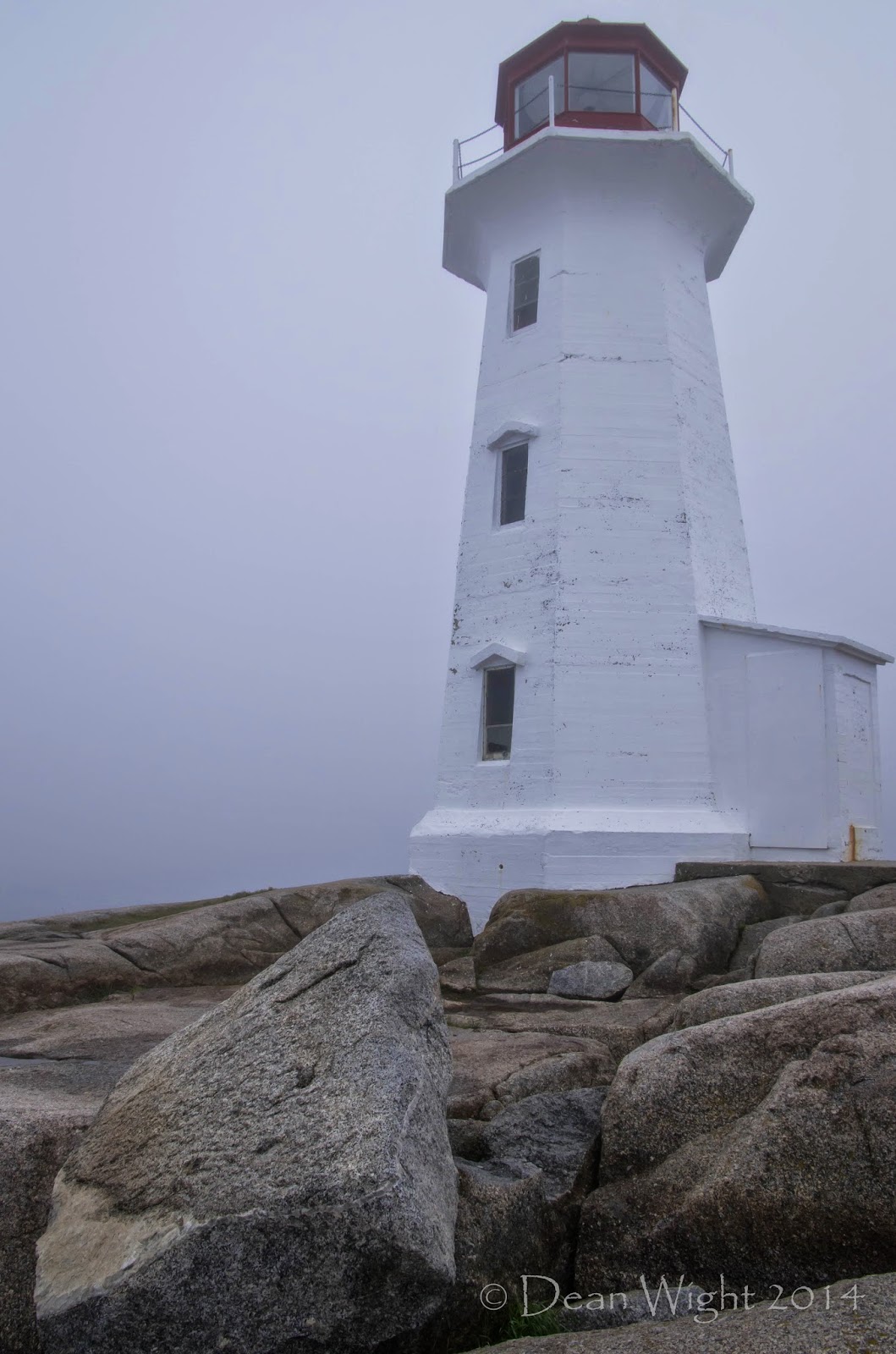
Lighthouse at Peggy's Cove
Like many villages we visited, Peggy's Cove is a working fishery. That isn't surprising, since Nova Scotia is almost surrounded by water and is near major fishing resources. It's one of many factors that make it a fascinating province (others include a contentious political history, settlement by several nations and cultures, a complex geology and a phenomenal tidal range in the Bay of Fundy). I will add photos from others parts of Nova Scotia in later posts.

Boats at Peggy's Cove

Freedom 55
The details: 
(Lighthouse) Pentax K-5 handheld 1/2000 sec. at f/8, ISO 400, 16mm (smc Pentax-DA* 16-50mm F2.8 ED AL [IF] SDM)
(Boats) Pentax K-5 handheld 1/1000 sec. at f/8, ISO 800, 16mm (smc Pentax-DA* 16-50mm F2.8 ED AL [IF] SDM)
(Freedom) Pentax K-5 handheld 1/1000 sec. at f/8, ISO 800, 43mm (smc Pentax-DA* 16-50mm F2.8 ED AL [IF] SDM)

Tuesday, June 24, 2014

Southwest Utah

Those of us who live in the eastern woodlands sometimes can't see the forest or the trees, so densely do they surround us. Spring has been very wet in Maryland this year, and vegetation has gone wild. So it was exciting to find ourselves in a completely different environment recently when we helped our son relocate to Cedar City, Utah, an attractive town in the southwest corner of the state.

I had some idea of what to expect. As an undergraduate geology student in the 1970's I spent several weeks in Silver City, New Mexico, making maps of a very dry area. I knew vegetation would be sparse (that's one reason they send neophyte geologists to such places: it's easier to see the rocks). But I had forgotten how much variety and drama there can be in arid landscapes. I was reminded on this trip, which included a visually delicious three hour drive south from Salt Lake City, and a stunning return drive at sunrise. But as this was a working trip with a tight schedule, no images were made along Interstate 15.

However, while in Cedar City I took a short drive up Cedar Canyon to make a few shots of the beautiful multicolored hills. Another day I wandered down to a creek near our hotel, where the vegetation was thick and the thistle in bloom. I can understand how photographers spend lifetimes in the American West yet feel they haven't seen everything. It is so compelling, and so vast.

Red Hill near Cedar City, Utah

Thistle and Grass

The details:  
(Red Hill) Pentax K-5 handheld 1/1000 sec. at f/8, ISO 400, 22mm (smc Pentax-DA* 16-50mm F2.8 ED AL [IF] SDM)
(Thistle) Pentax K-5 handheld 1/320 sec. at f/8, ISO 400, 50mm (smc Pentax-DA* 16-50mm F2.8 ED AL [IF] SDM)