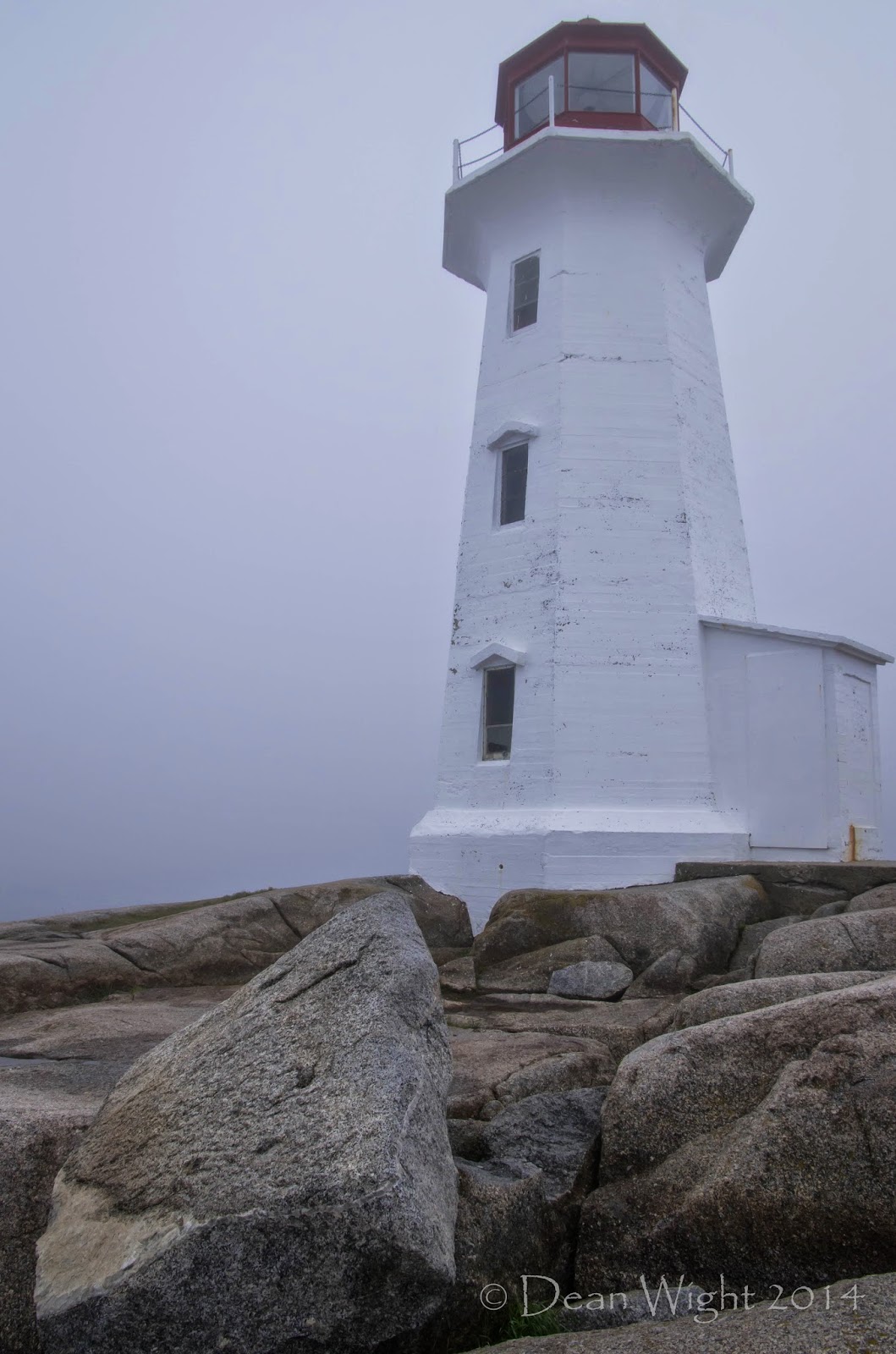
Our recent trip to Nova Scotia convinced me I'd be happier with a lighter kit. I currently carry a Pentax K-5, a Pentax 16-50mm f2.8 zoom, and a Sigma 70-300mm f4-5.6 macro zoom in a Lowepro Fastpack 200 backpack. It weighs almost 9 pounds; with the laptop I include when traveling, over 11 pounds. Doesn't sound too bad, but carrying it on multi-hour hikes became tiring. The last straw was deciding to leave it home one morning and consequently missing a shot of a bald eagle perched less than 100 feet away on a beautiful rock overlooking an azure ocean. Nuts.
I've watched with interest as mirrorless cameras have become the next big thing. "Big" only figuratively; they are substantially smaller and lighter than conventional DSLRs. The Fujifilm XT-1 and the Olympus OM-D EM-1 (who makes up these names?) have garnered praise, so I rented each for a few days from Lensrentals.com.
I found it hard to get used to the electronic viewfinders. They are wonderfully bright, even in dim light--terrific for available light shooting, as I found when shooting with the Fuji at an outdoor evening event. But in daylight the viewfinders tend to hunt for the right illumination level as bright light and shadow areas move through the view, which I find disconcerting. They also have a bit of time lag that is a little distracting. And probably my 40+ years of using optical viewfinders has conditioned me to such an extent that it's just hard to adapt.
Both cameras fit my hand well, start up fast and are responsive in shooting. Their designs differ somewhat. The Fuji has more physical dials, reminiscent of film SLRs, and I found it pretty easy to use. The Olympus relies more on menus, menus, menus. I didn't use either one enough to form an opinion about their auto-focus, but I did miss several shots relying on it. Might have been user error, since a couple days is not enough time to learn a camera. I was too cheap to spend more than the approximately $200 it cost for a camera and two lenses for four or five days, and life kept me from testing them on several days.
But I took a lot of A-B comparison shots with the Pentax and Fuji, and also with the Pentax and Olympus. To make sure I had good exposures, I used exposure bracketing on all three cameras. When I sat down to look at the images I discovered that Lightroom 4 doesn't support the Fuji or Olympus raw formats. The workaround is to download Adobe's free DNG converter and use it to convert the raws to DNG format (I don't need to do this with the Pentax because it supports DNG in camera.) After that exercise I was able to import them into Lightroom and use its comparison tool to really look at them side by side.
The main finding: my Pentax 16-50 zoom isn't working well. No matter how carefully I tried, its images weren't as crisp as those from the Sigma on the K-5 or the other four lenses on the Fuji and Olympus. There is some history: the 16-50 has been in the shop once. I bought it and the K-5 new at the same time, and something was seriously out of whack. I had purple fringing at a hallucinogenic level. Camera and lens went back to Pentax, who sent me a different K-5 body and the same lens, which they said had been adjusted to meet specs. I think something has changed, and I suspect it is in the 16-50.
It's worth noting that the Fuji has an APS-C sized sensor, like the Pentax, while the Olympus uses a smaller, micro four thirds sensor. I was interested to see whether I would notice a difference. The answer is yes, but only when looking at pretty large magnification. If I often made big prints, I think I would favor the APS-C. And the Fuji is very similar to the Olympus in size and weight, which matter to me quite a bit. Advantage Fuji.
In the end, though, I decided not to buy a new camera. Our next trip is to Italy--God knows, a photogenic place--but our tour operator warns about theft, and repeatedly urges us to pack light. At this point I believe I will rely solely on the iPhone 5s (which I've written about here and here). There is more to life than photography...I'll keep repeating it like a mantra...and when we return I can concentrate on weightier work, so to speak, and get the 16-50 repaired.
If you've read this far, you might want to see some images from the Fuji and the Olympus. Here they are. Remember that these are JPEGs made from the raw files. The only tweaking was Lightroom's low sharpening for screen, so don't read too much into them. You can see some vignetting in the upper left of the Olympus 12mm (bottom shot). All were shot at the Rocky Islands at Great Falls in the Chesapeake and Ohio Canal National Historical Park.


The details: (Top) Fuji XT-1 handheld, 1/1900 sec. at f4.0, ISO 400, 23mm (SF23mmF1.4 R)
(Second) Fuji XT-1 handheld, 1/450 sec. at f8.0, ISO 400, 35mm (XSF55-200mmF3.5-4.8 R LM OIS)
(Third) Olympus OM-D EM-1 handheld, 1/200 sec. at f8.0, ISO 100, 47mm (LUMIX G VARIO 35-100mm/F2.8)
(Bottom) Olympus OM-D EM-1 handheld, 1/2000 sec. at f2.8, ISO 100, 12mm (LUMIX G VARIO 12-35mm/F2.8)
I've watched with interest as mirrorless cameras have become the next big thing. "Big" only figuratively; they are substantially smaller and lighter than conventional DSLRs. The Fujifilm XT-1 and the Olympus OM-D EM-1 (who makes up these names?) have garnered praise, so I rented each for a few days from Lensrentals.com.
I found it hard to get used to the electronic viewfinders. They are wonderfully bright, even in dim light--terrific for available light shooting, as I found when shooting with the Fuji at an outdoor evening event. But in daylight the viewfinders tend to hunt for the right illumination level as bright light and shadow areas move through the view, which I find disconcerting. They also have a bit of time lag that is a little distracting. And probably my 40+ years of using optical viewfinders has conditioned me to such an extent that it's just hard to adapt.
Both cameras fit my hand well, start up fast and are responsive in shooting. Their designs differ somewhat. The Fuji has more physical dials, reminiscent of film SLRs, and I found it pretty easy to use. The Olympus relies more on menus, menus, menus. I didn't use either one enough to form an opinion about their auto-focus, but I did miss several shots relying on it. Might have been user error, since a couple days is not enough time to learn a camera. I was too cheap to spend more than the approximately $200 it cost for a camera and two lenses for four or five days, and life kept me from testing them on several days.
But I took a lot of A-B comparison shots with the Pentax and Fuji, and also with the Pentax and Olympus. To make sure I had good exposures, I used exposure bracketing on all three cameras. When I sat down to look at the images I discovered that Lightroom 4 doesn't support the Fuji or Olympus raw formats. The workaround is to download Adobe's free DNG converter and use it to convert the raws to DNG format (I don't need to do this with the Pentax because it supports DNG in camera.) After that exercise I was able to import them into Lightroom and use its comparison tool to really look at them side by side.
The main finding: my Pentax 16-50 zoom isn't working well. No matter how carefully I tried, its images weren't as crisp as those from the Sigma on the K-5 or the other four lenses on the Fuji and Olympus. There is some history: the 16-50 has been in the shop once. I bought it and the K-5 new at the same time, and something was seriously out of whack. I had purple fringing at a hallucinogenic level. Camera and lens went back to Pentax, who sent me a different K-5 body and the same lens, which they said had been adjusted to meet specs. I think something has changed, and I suspect it is in the 16-50.
It's worth noting that the Fuji has an APS-C sized sensor, like the Pentax, while the Olympus uses a smaller, micro four thirds sensor. I was interested to see whether I would notice a difference. The answer is yes, but only when looking at pretty large magnification. If I often made big prints, I think I would favor the APS-C. And the Fuji is very similar to the Olympus in size and weight, which matter to me quite a bit. Advantage Fuji.
In the end, though, I decided not to buy a new camera. Our next trip is to Italy--God knows, a photogenic place--but our tour operator warns about theft, and repeatedly urges us to pack light. At this point I believe I will rely solely on the iPhone 5s (which I've written about here and here). There is more to life than photography...I'll keep repeating it like a mantra...and when we return I can concentrate on weightier work, so to speak, and get the 16-50 repaired.
If you've read this far, you might want to see some images from the Fuji and the Olympus. Here they are. Remember that these are JPEGs made from the raw files. The only tweaking was Lightroom's low sharpening for screen, so don't read too much into them. You can see some vignetting in the upper left of the Olympus 12mm (bottom shot). All were shot at the Rocky Islands at Great Falls in the Chesapeake and Ohio Canal National Historical Park.
The details: (Top) Fuji XT-1 handheld, 1/1900 sec. at f4.0, ISO 400, 23mm (SF23mmF1.4 R)
(Second) Fuji XT-1 handheld, 1/450 sec. at f8.0, ISO 400, 35mm (XSF55-200mmF3.5-4.8 R LM OIS)
(Third) Olympus OM-D EM-1 handheld, 1/200 sec. at f8.0, ISO 100, 47mm (LUMIX G VARIO 35-100mm/F2.8)
(Bottom) Olympus OM-D EM-1 handheld, 1/2000 sec. at f2.8, ISO 100, 12mm (LUMIX G VARIO 12-35mm/F2.8)